 Kitsumi
Free basic Swahili words
A seven-page printable PDF for your first weeks of Swahili: how it sounds, how words work, 260 everyday words, sayings and sentences to read aloud.
PDF · 7 pages · 304 KB · no sign-up · free to print and share
Was it useful?Ideas or a mistake? Tell us on Discord
Next, meet these words in real videos: Kitsumi is free for Chrome and Firefox.
What's inside
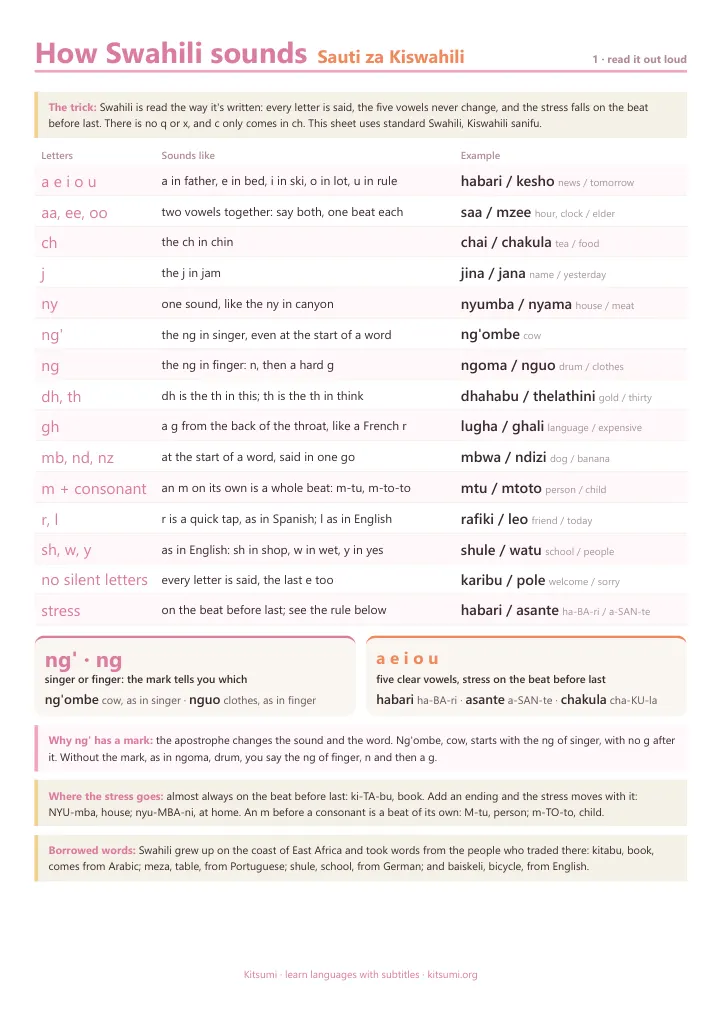
- How Swahili soundsStandard Swahili, read the way it's written: five clear vowels, every letter said, ch, j and ny, ng' as in singer and ng as in finger, dh and th, gh, mb and nd at the start of a word, an m that is a beat of its own, and the stress on the beat before last.
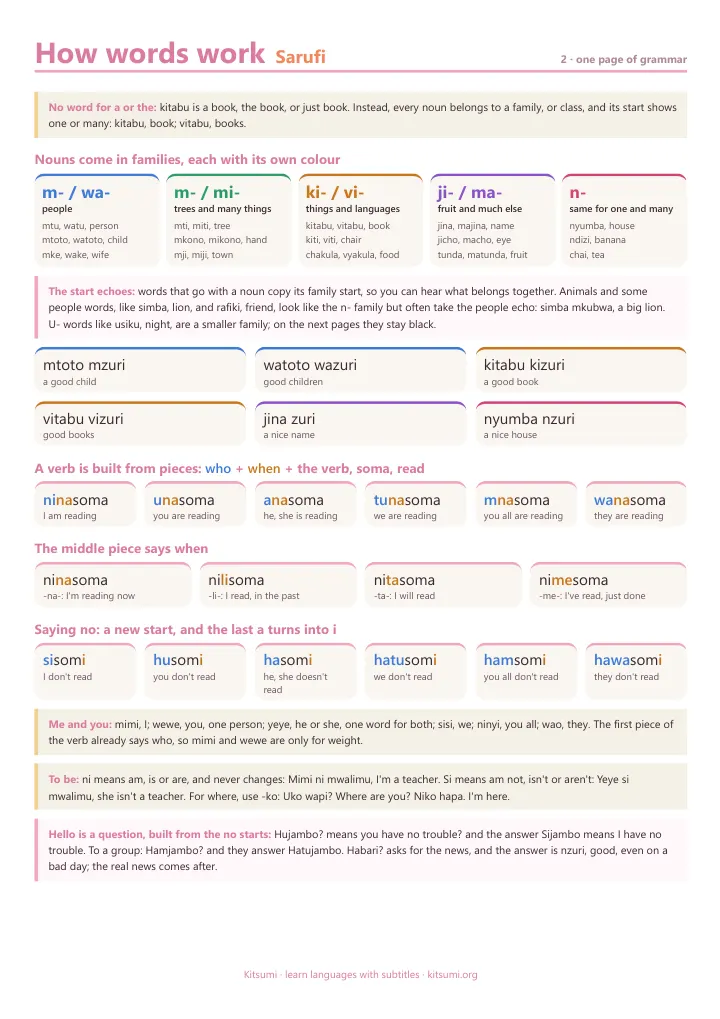
- How words workNo word for a or the, nouns in five colour-coded families (mtu, watu; kitabu, vitabu; jina, majina), describing words that copy the family, verbs built from pieces (ninasoma, unasoma, anasoma), -na-, -li-, -ta- and -me- for time, sisomi for not, ni and si for to be, and why hello is Hujambo? and the answer Sijambo.
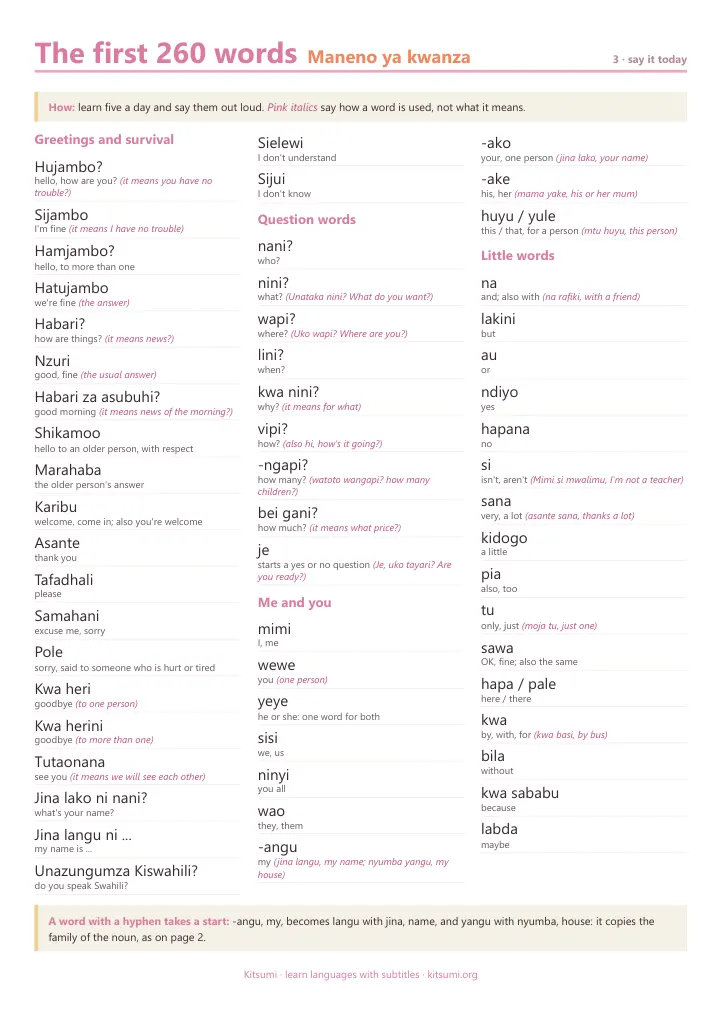
- 260 words, then sayingsHabari?, karibu and asante, family, numbers and Swahili time, food, places and verbs. Then hakuna matata, pole pole and proverbs, hongera! and kumbe!, what to call people, and ten sentences to read before you check.
How to use it
- Read the sounds page aloud, one row at a time. Keep it next to you while you read the rest.
- Read the grammar page twice. You don't need to learn it, just to notice the five colours and how the start of a word changes with the family.
- Learn five words a day. Cover the grey English on the last page, read each sentence aloud, then slide the paper down to check.
- Watch or read something in Swahili with Kitsumi and hover any word you don't know to see what it means.
Printables for other languages
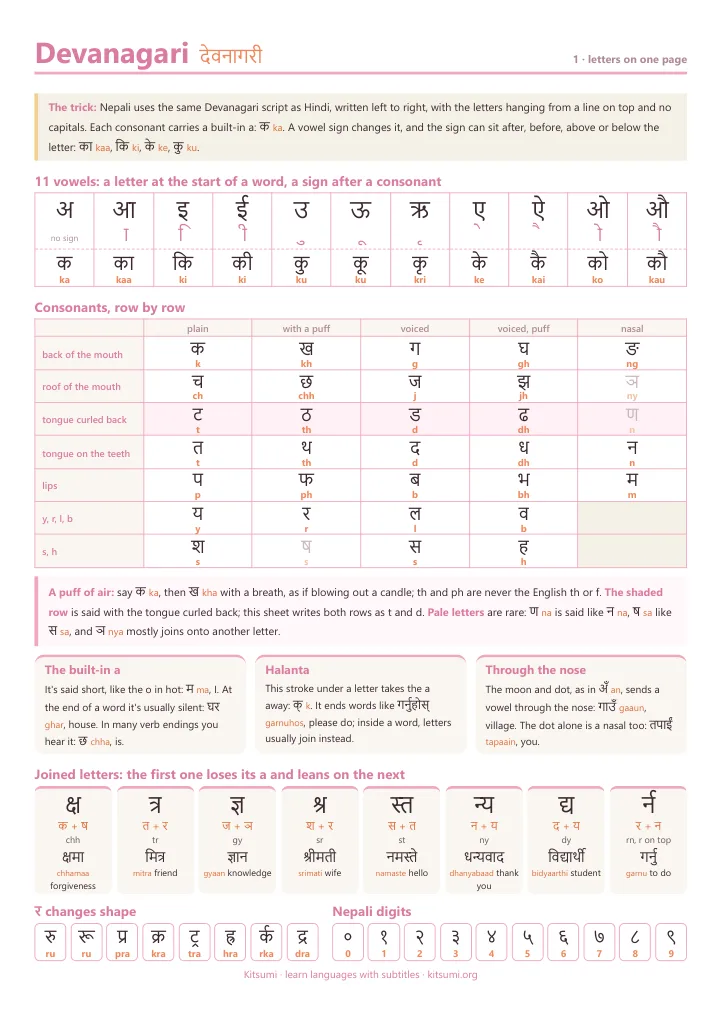 Nepali script and first wordsStart here. The letters on one page, the built-in a and halanta, the four ways to say you and the two words for to be, then 263 first words of everyday Nepali, each with a simple romanization.
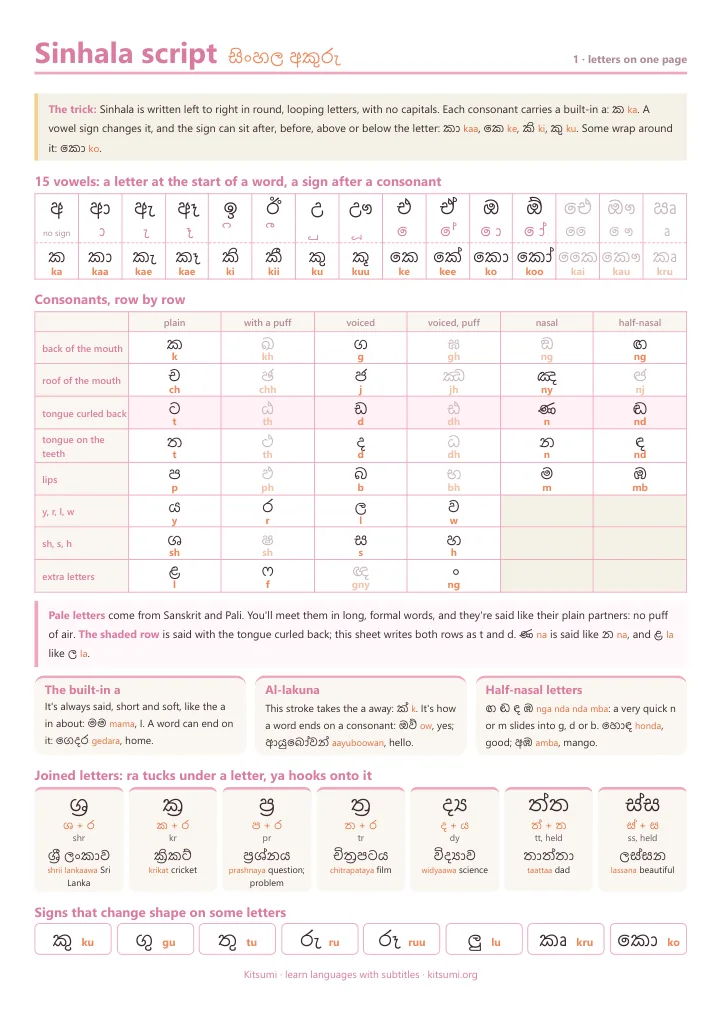 Sinhala script and first wordsStart here. The letters on one page, the built-in a and al-lakuna, one verb form for everyone and how to say you, then 259 first words of spoken Sinhala, each with a simple romanization.
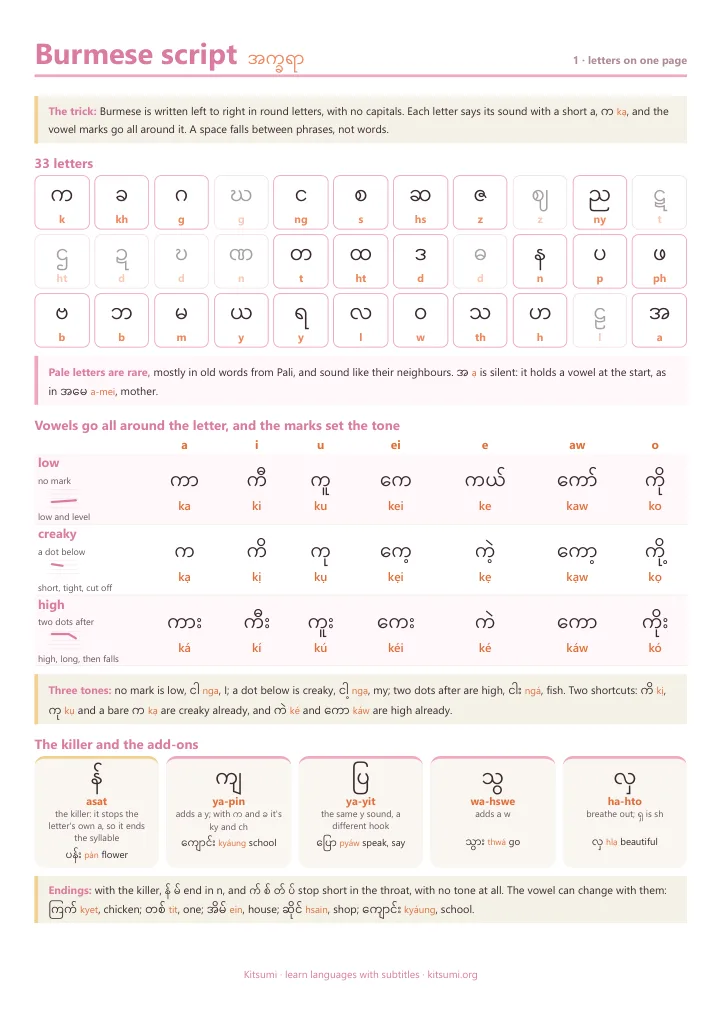 Burmese script and first wordsStart here. The round letters on one page, three tones you can read off the marks, polite words for men and women, then 247 first words, each with a romanization that shows its tone.
Questions
Is it free?
Yes. It's a free PDF with no sign-up. Print it, keep it and share it.
Which Swahili does it use?
Standard Swahili, Kiswahili sanifu, the form taught in schools in Tanzania and Kenya and used in news and books. Everyday speech varies by region, but this is the one everyone understands.
What are the coloured words?
Swahili sorts nouns into families, or classes, instead of masculine and feminine. Each colour is one family, and the words that go with a noun copy its start, so the colour tells you how the rest of the sentence will sound.